Data scattered across departments
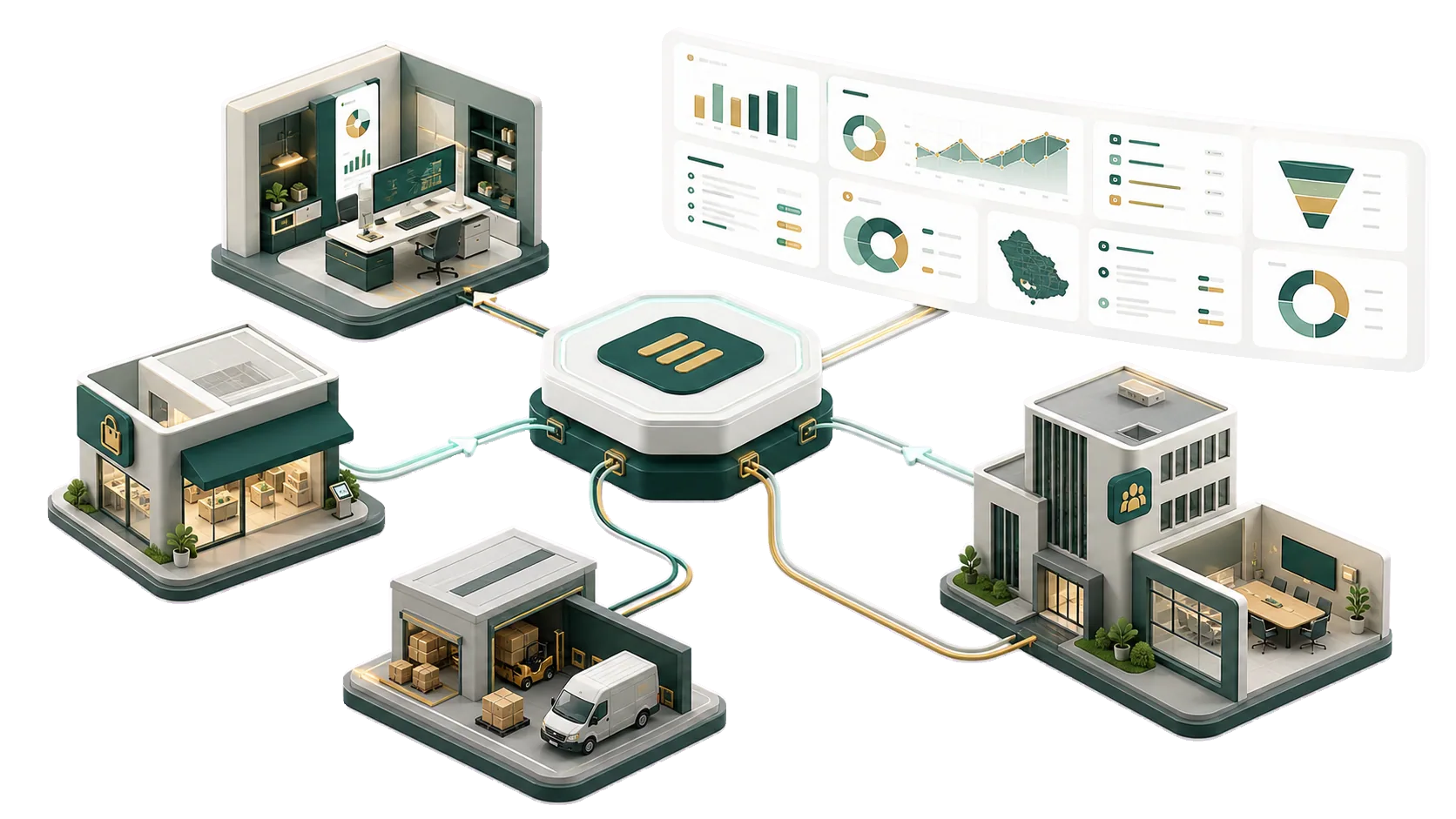
Sales keeps its own customer list, the warehouse keeps its own stock sheet, and finance rebuilds both at month-end. In ERPNext they are modules working on the same records.

ERPNext industry solutions
Not every company is a factory. Trading and service businesses in Saudi Arabia can run sales, customers, inventory, projects and finance on ERPNext, and IBAN sets it up around the way you work.
Trading and service companies tend to run into these once they outgrow a handful of staff and a single warehouse.
Sales keeps its own customer list, the warehouse keeps its own stock sheet, and finance rebuilds both at month-end. In ERPNext they are modules working on the same records.
When orders, stock and internal tasks are tracked separately, delays show up late and it is hard to say what is finished and what is still open.
Leads kept in inboxes get forgotten. Without a path from lead to opportunity to quotation, follow-up depends on each salesperson’s memory.
If sales and purchases are keyed into accounting later, the figures always lag behind. ERPNext posts each submitted invoice and receipt to the General Ledger straight away.
Copying the same order into several files takes hours and adds a fresh chance of error at every step.
When figures come from several sources, a management report becomes a project of its own. With the data in ERPNext, reports such as Accounts Receivable, Gross Profit and Stock Balance are ready when you open them.
The day-to-day work, and where each part of it connects to the accounts and to your reports.
A lead becomes an opportunity, then a quotation, then a sales order. Each step is created from the last, so you can see where every deal stands and nothing is typed again.
Stock levels change with every receipt and delivery, by warehouse. The Inventory module also handles serial and batch numbers and the standard stock reports.
For internal work or client projects, the Projects module tracks tasks, timesheets, expenses and materials against each project.
Forms, reports and dashboards can be adjusted to how your managers read the numbers, whether you are a small trading company or a group with several branches.
Yes. Accounting, Sales, CRM, Inventory, Projects and Purchasing are all standard modules, so a trading or service company can run its core work in ERPNext without extra apps.
Yes. CRM covers leads and opportunities, Sales covers quotations and sales orders, and Inventory tracks items by warehouse. When you submit a Delivery Note, stock goes down for the items shipped.
Yes. The Projects module handles projects, tasks and timesheets, with costs booked against each project.
Yes. Every submitted transaction posts to the General Ledger, and the standard reports include the Trial Balance, Profit and Loss, Balance Sheet and Accounts Receivable.
Yes. You can start with the core modules you need now and add others as the company grows.
We look at how you work today, pick the modules, then handle setup, integration and training.
Pick the service you need, leave your details, and we will get back to you shortly.
We start by looking at how you work today, then agree on the modules, integrations and reports you need before implementation begins.
Talk to an ERPNext expert