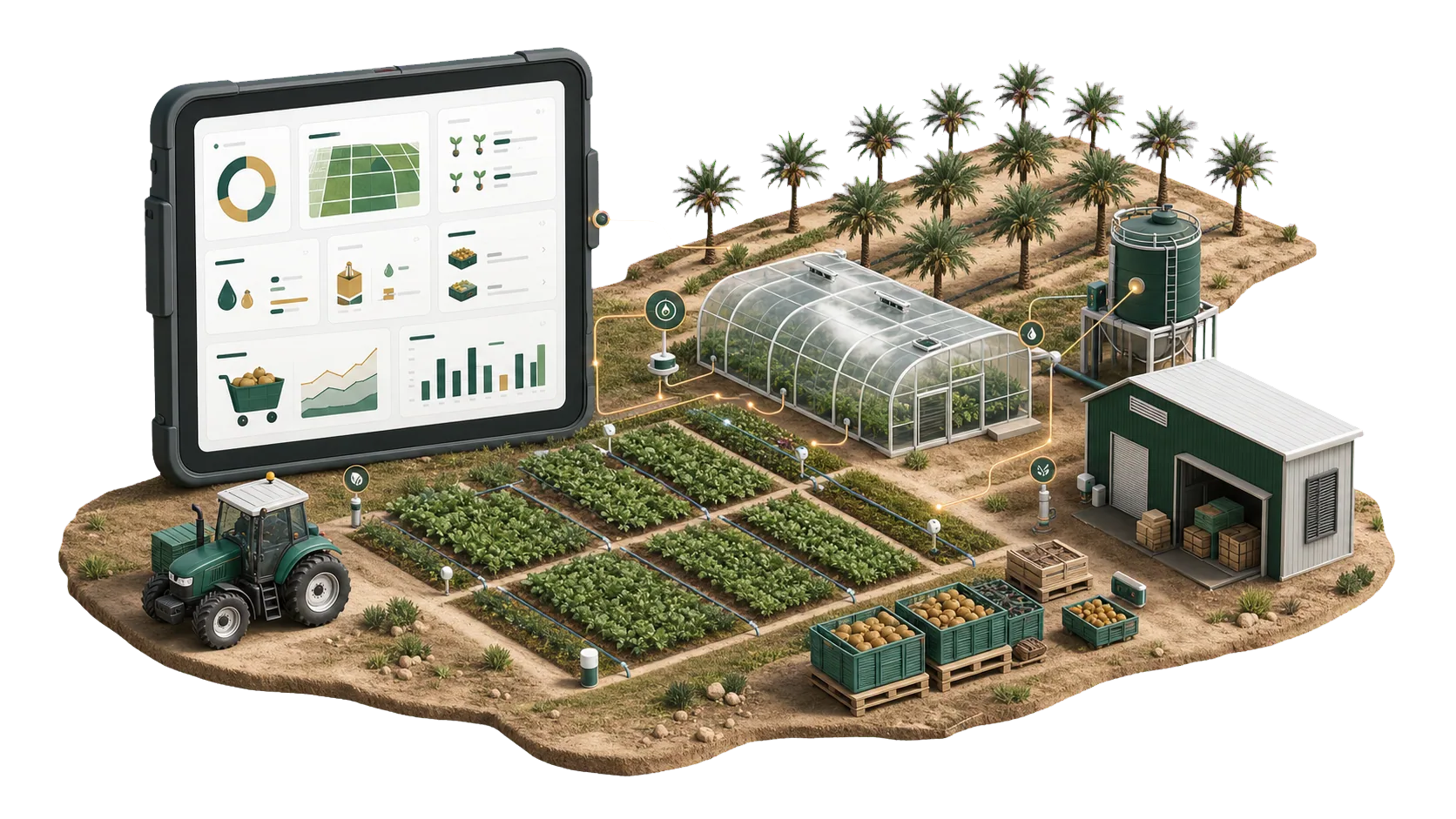
IBAN builds a farm module on ERPNext for farms in Saudi Arabia. Date palm work is scheduled by plot, every animal has its own record, and feed is issued from stock to each barn. Ask for a demo on your own farm data.
These are the problems we hear about most in first meetings. Further down, you can see how each one is handled in ERPNext.
One profit figure for the whole farm
The farm made money this year. Which barn or plot earned it, and which one lost? With a single total, a losing activity can be carried by a good one for years before anyone notices. The farm module gives each barn and plot its own cost center.
Palm season work that slips
Pollination, fruit thinning, bunch bending and covering, then harvest. Each job has a short window, and a late one can cost a plot its crop. The module sets them up as recurring tasks per plot, with a due date, an owner and the materials needed, and reminds the team before the date.
A herd you can count but can’t cost
A herd book tells you what happened. It can’t tell you what each animal has cost so far. Here every head has an ID, such as an ear tag or chip number, plus its barn, weight history and treatments, and its cost builds up with each entry.
Feed conversion worked out too late
Calculated once when the cycle closes, feed conversion ratio arrives after the chance to act has passed. Estimated feed makes it worse, because the ratio then looks better than your feed bill. Issue feed to each barn from stock and record weights during the cycle, and the ratio updates as you go.
The same work recorded twice
The supervisor writes it in a logbook, then someone in the office copies it into a parallel Excel file. You end up paying for a system and working outside it.
Sales billed in a separate program
When invoices come from a separate billing tool, sales, stock and accounts have to be matched by hand. In the module, selling a batch of birds or a load of dates creates the invoice, the accounting entry and the stock movement together.
In practice
ERPNext for Agriculture & Farms in practice
The day-to-day work, and where each part of it connects to the accounts and to your reports.
Date palm plots
Each plot has its own season tasks, and the harvest is recorded by plot and variety. Divide the plot’s season costs by the kilograms it produced and you have the cost of a kilo of dates.
Herd and animal records
An animal comes in by birth or purchase, moves between barns, gets weighed and treated, and leaves by sale, death or culling. Its purchase price, treatments and share of barn feed add up to what it has cost.
Feed issued from stock
Feed goes from the warehouse to a barn on a Stock Entry, in kilograms. Tied to the cycle and to regular weight samples, it gives you feed conversion ratio and income for each cycle.
Profit by barn, plot and cycle
Purchase orders, stock issues and Sales Invoices carry a cost center, so Profit and Loss runs per barn, plot or cycle. Living stock is valued at accumulated cost: what the animal cost plus what has been spent on it since.
Yes, with IBAN’s farm module. Core ERPNext no longer ships agriculture features, so we built a farm module on top of it. It covers date palm season work by plot, livestock records, feed issue and feed conversion ratio, and farm accounting by cost center. We can demo it on your own farm data.
Can it schedule date palm work?
Yes. Each seasonal job, from pollination to harvest, is a recurring task for a plot with a due date, an owner and the materials it needs. When the job is done, the team records the materials and labor used, and that cost goes to the plot.
Can I keep a record for each animal?
Yes. Each head has an ID such as an ear tag or chip number, along with its barn moves, weights, vaccinations and treatments. Sheep, camels and cattle can run side by side, with reports and costs kept apart for each.
Does it calculate feed conversion ratio?
Yes, as long as feed is issued from stock to each barn and weights are recorded regularly. The ratio is then worked out for each barn and cycle. Multiply it by the price of a kilo of feed to see the feed cost in every kilo produced.
Can farm operations be linked to accounts and invoices?
Yes. Stock issues and sales carry the cost center of the barn or plot, which gives each one its own Profit and Loss. Sales Invoices meet ZATCA e-invoicing requirements through the compliance app we set up alongside ERPNext.
How do I get started with IBAN?
Ask for a demo of the farm module using your own farm data. Then we list your plots, barns and animals, set cost centers at the level you make decisions on, and run one full season or cycle before comparing results.
Contact us
Tell us about your project.
Pick the service you need, leave your details, and we will get back to you shortly.